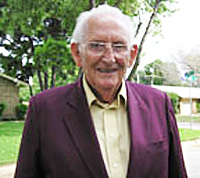
Picture taken in 2010
Picture taken in 2010
Myles Thomas Tune (Tom) was born in Murray, Kentucky, May 12, 1929. He died on February 5, 2013 at the age of 83.
He joined the Navy at age 16 near the end of WWII and after his time in the service moved to Nashville, Tennessee.
Tom had been raised in the Baptist church, but on arrival in Nashville he was influenced by his wife-to-be, Charlene Porch, for the cause of New Testament Christianity. Under the influence of preachers like Don Rudd and Don Hinds in Old Hickory, Tennessee, Tom took some Bible classes at David Lipscomb College until he had to drop out due to lack of money.
In those early years (1954-1958) Tom preached in Kentucky and Gallatin, Tennessee where he had a radio program. He used his income as a businessman in Nashville (he owned an upholstery and antique refinishing shop across the street from the building of the Madison church of Christ) to finance his preaching.
It was during this time that he became an ardent civil rights advocate. Under the auspices of the Rayon City church in Old Hickory, Tennessee, Tom began publishing a paper called The Flame. The Rayon city church held the first integrated tent meeting in Nashville in August of 1958 with G.P. Holt (of Oklahoma City at the time) preaching. Tom and his wife Charlene paid for the large tent themselves and it was used for a variety of tent meetings for several years after that.
In 1959, Tom moved to California to do local work with the Pleasant Hill congregation. Though he was working "full-time" with this church, he also had to do secular work to pay the bills. The Lord blessed him and business was good. His weekly contribution was in excess of his weekly salary as a preacher. He once again began publishing a paper, this time known as The Reaper. His articles on race relations were watershed journalism for that time and much was accomplished to provide unity among the races in the Church in California. It was also during this period that he became known as an accomplished debater.
In 1961, Tom and his family became the first white family to be sent as missionaries to a foreign land supported entirely by black people. It was also at this time, just before leaving, that he took his first language course (Mandarin) and took on the nickname by which most of the brethren know him: Tom.
In Hong Kong, Tom published a song book allowing English-speaking people to sing hymns in Chinese -- without even knowing Chinese. This opened the door to closer relations between the English speaking brethren and the Chinese brethren. The first church building owned by the brethren was built at a fishing village in Hong Kong and was one of several congregations Tom started. He also built a Christian School there.
Tom returned to the States in 1966, his family all but worn out. The strain of foreign missions and Tom's consuming commitment to world evangelism contributed to the break-up of his marriage. He once again went into business. In 1972, he became one of the owners of the Christian Chronicle and moved the paper to Nashville. Tom served as business manager until 1974. It was during this time that he wrote his first book, Ah Wing's Elizabeth Bernard. His work was based on hours of recorded interviews with this Christian Lady while in Hong Kong.
In 1978 Tom opened a business in Little Rock, Arkansas and began to work toward a dream of returning to China with a boat to reach the normally unreachable people of the fishing villages. The Lord made him to prosper and he purchased a 45-foot sailboat which he named the Dorcas Sue in 1979. It was also during this time that Tom invented a way of fitting eyeglasses in primitive countries at a cost of only $10 per pair of glasses. During the years that followed, Tom sailed that boat on mission trips to South America and the Mediterranean, taking medicine and fitting glasses. When he attempted to go on and realize his dream of going to China, he was stopped mid-voyage when his ship was hijacked. From those voyages he wrote three other books about his missionary journeys.
The ship was later returned, but by that time the struggle had worn him out physically and financially. He sailed back to the United States to once again go into business and then back to the mission field.
In 1991, Tom sailed for China once again, this time determined to cross the pacific. The Lord stopped him at the Cook Islands where he has served for seven years, fitting glasses under the protection and approval of the Cook Island government. At that time he was sponsored by the Maple Hill church of Christ in Lebanon, Tennessee.
After a visit to the United States, at the age of 68, Tom set sail again with the Dorcas Sue in March of 1998 to return to his work in the Cook Islands.
In 2005 Tom went to Vietnam to oversee the bulding of the "Ship of Life" (a medical missions boat now used along the Mekong River in Cambodia). When he noticed that many children were not in school because their parents could not afford the fees, he started a program that has enabled more than a hundred children to attend school. During the boat's construction, Tom started meeting with a handful of Vietnamese Christians and helped them to develop a congregtion of over a hundred people. He also started another congregation in Vietnam.
While visiting in the States at the end of 2012 Tom learned that he had a serious heart condition that would require an operation. Before it could be arranged, however, he also developed lung problems which became worse. He passed away on February 5, 2013.
